Problem solving
What Hard Water Does to Your Plumbing
Published November 1, 2026. Updated November 1, 2026.
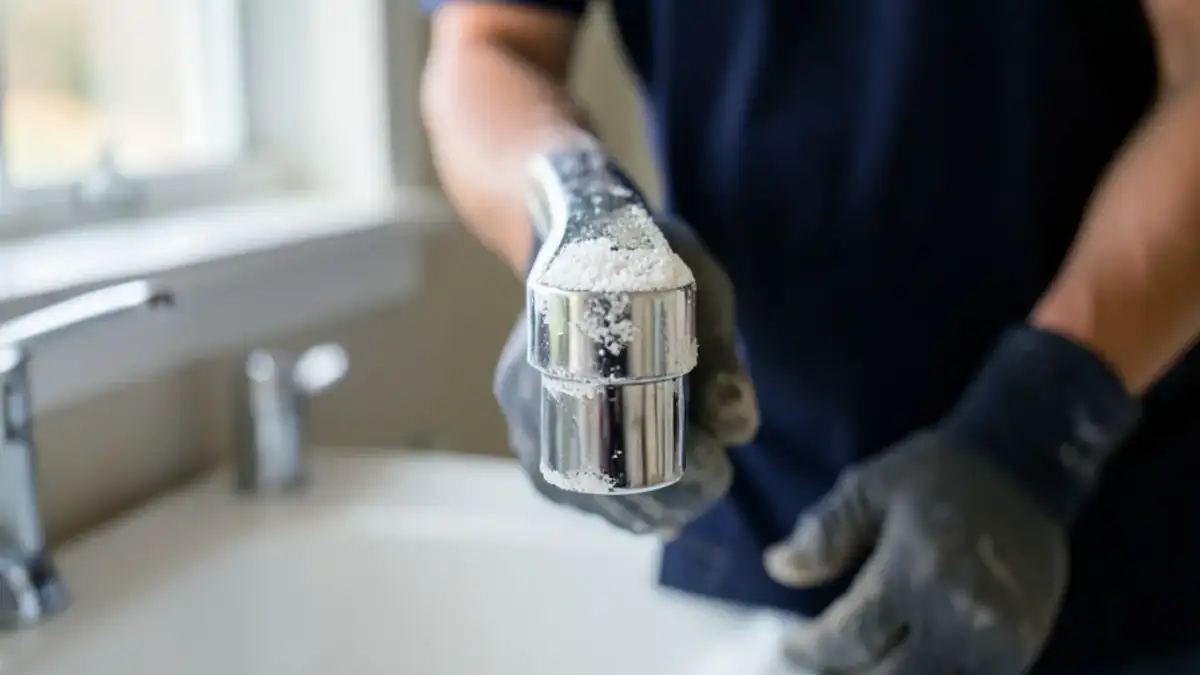
Hard water effects on plumbing come from dissolved calcium and magnesium that settle out as scale. The scale narrows pipes, coats heating surfaces, clogs aerators and shortens the life of water heaters. Almost all of Illinois has hard or very hard water, but the level varies by supply, so a test tells you what you actually have.
What Is Hard Water, and Is Yours Hard?
Hard water carries dissolved calcium and magnesium, and in Illinois almost everyone has some. The City of St. Charles, citing a University of Illinois Extension chart, says almost all of Illinois has hard or very hard water, picked up as groundwater moves through rock and soil. How hard depends on the supply.
The chart sorts water into bands:
| Level | Grains per gallon | mg/L (ppm) |
|---|---|---|
| Soft | Below 1.0 | Below 17.1 |
| Slightly hard | 1.0 to 3.5 | 17.1 to 60 |
| Moderately hard | 3.5 to 7.5 | 61 to 120 |
| Hard | 7.5 to 10.5 | 121 to 180 |
| Very hard | Above 10.5 | Above 180 |
We do not quote a hardness number for any local town. Supplies differ, and the figures published online conflict. Your utility's annual water quality report lists it, and a test settles it.
Scale building up in your plumbing? Call (209) 563-1400
Open 7 days, 7:15 AM to 6:15 PM. Tell us what is happening and we will give you a clear, upfront quote.
What Does Hard Water Do Inside Your Plumbing?
It leaves scale. Calcium and magnesium carbonates come out of the water as solids on the inside of pipes and heat exchangers, and the buildup restricts flow (Wikipedia's hard water article summarizes this). Heat speeds the process, which is why hot lines and heating surfaces scale first.
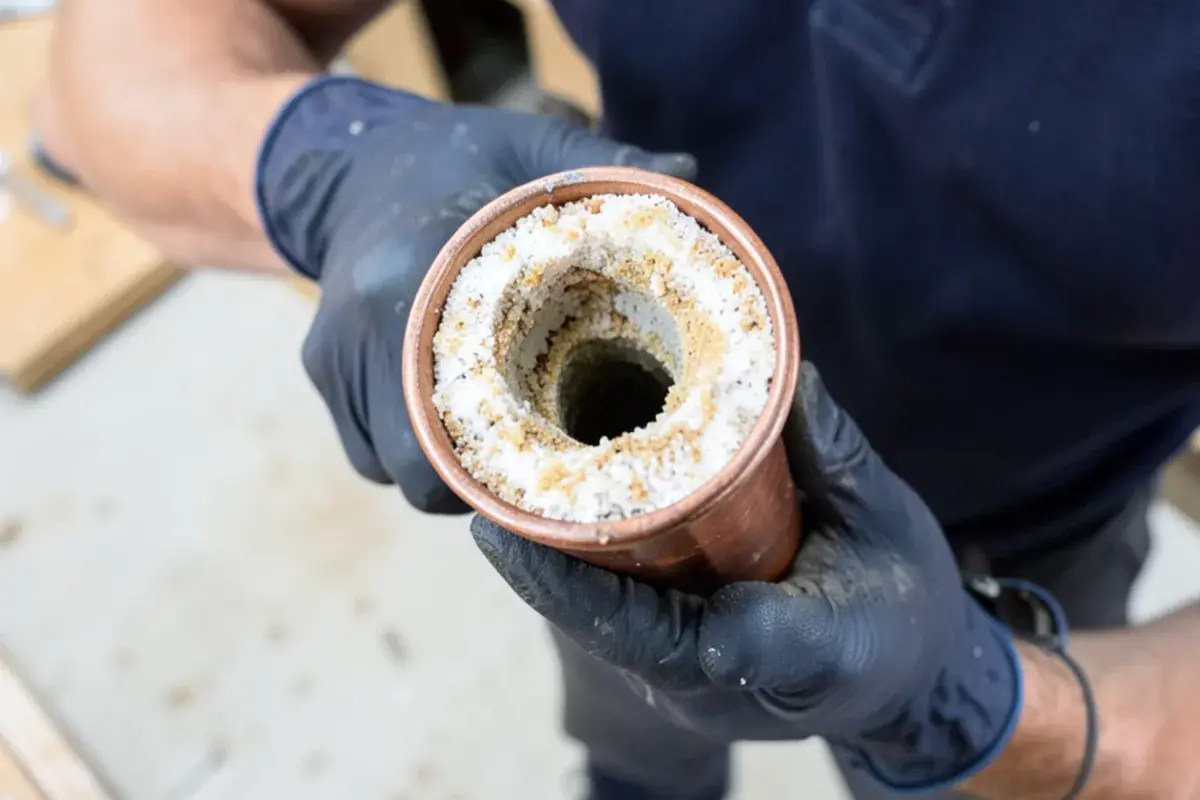
You can often see the early signs before the pipes fail:
- White crust around faucets and showerheads
- A film on glassware and bathtub rings, both listed by the Extension chart
- Soap residue that is hard to rinse from clothes and skin
- Aerators and showerheads that spray unevenly
- Pressure that drops at one fixture while the rest are normal
White, Green or Orange: Reading the Stain
Color tells you what you are dealing with. White or chalky crust is mineral scale. Green or blue around copper fittings usually means corrosion, and it can mark a slow leak. Orange or brown points to rust from iron or galvanized pipe, or iron in the water. A softener answers the first one, and it does little for the other two.
Why Does Hot Water Scale So Much Faster Than Cold?
Heat changes the chemistry. Most hardness in tap water starts as dissolved calcium and magnesium bicarbonate, and heating converts it to carbonate, which comes out of the water as a solid. Wikipedia's hard water article calls this temporary hardness. The rest, from sulfates and chlorides, does not drop out as the water warms.
That is why two homes with the same hardness number can see different amounts of scale. The Langelier index, a measure that also uses pH, estimates whether water tends to leave deposits, and it climbs with temperature. So the hottest surface in the house, usually the heater, takes the worst of it. The pipe to the cold kitchen tap may stay clean for decades.
Which Parts of the House Take the Damage First?
The parts that heat water or squeeze it through small openings go first. The EPA's WaterSense program says scale conducts heat poorly and can reduce flow through pipes and fixtures, and Penn State Extension says hard water can damage any appliance that heats water.
| Part | What scale does | What you notice | Usual fix |
|---|---|---|---|
| Faucet aerator, showerhead | Blocks fine screens and nozzles | Uneven spray, weak flow | Soak, or swap for a new one |
| Faucet cartridge | Roughens the moving parts | Stiff handle, a drip | Replace the cartridge |
| Tank water heater | Coats the bottom or the elements | Rumbling, less hot water | Flush, element, or new tank |
| Tankless heater | Narrows the heat exchanger | Temperature swings | Descale on schedule |
| Dishwasher, washer | Catches at inlet screens | Slow fill, spotted glasses | Clean the screen |
| Galvanized supply pipe | Adds to rust on a rough wall | Falling pressure across the house | Replace the pipe |
How Does Hard Water Hurt Water Heaters?
Scale insulates the heating surface, so the heater works harder for less hot water. In a tank, minerals and sediment collect at the bottom. An electric element coated in scale can burn out. A gas burner heats the tank bottom through that layer, and the tank can rumble and lose capacity.
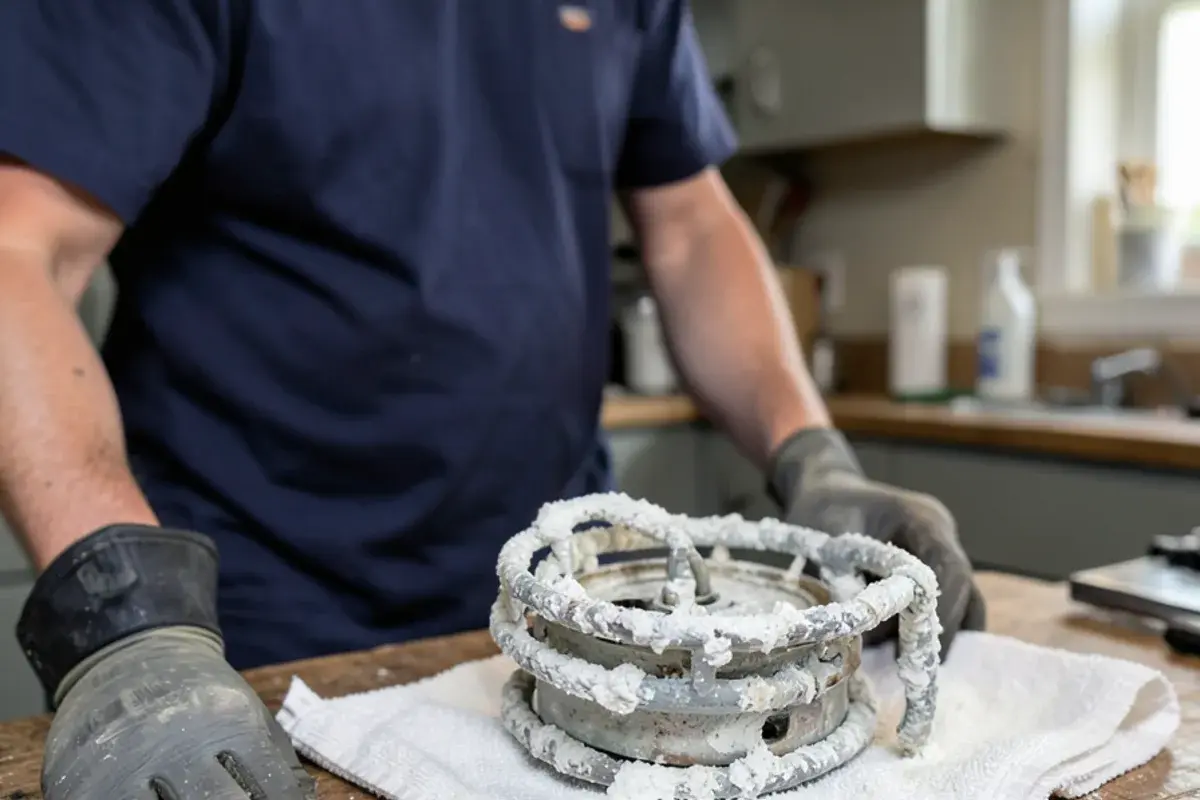
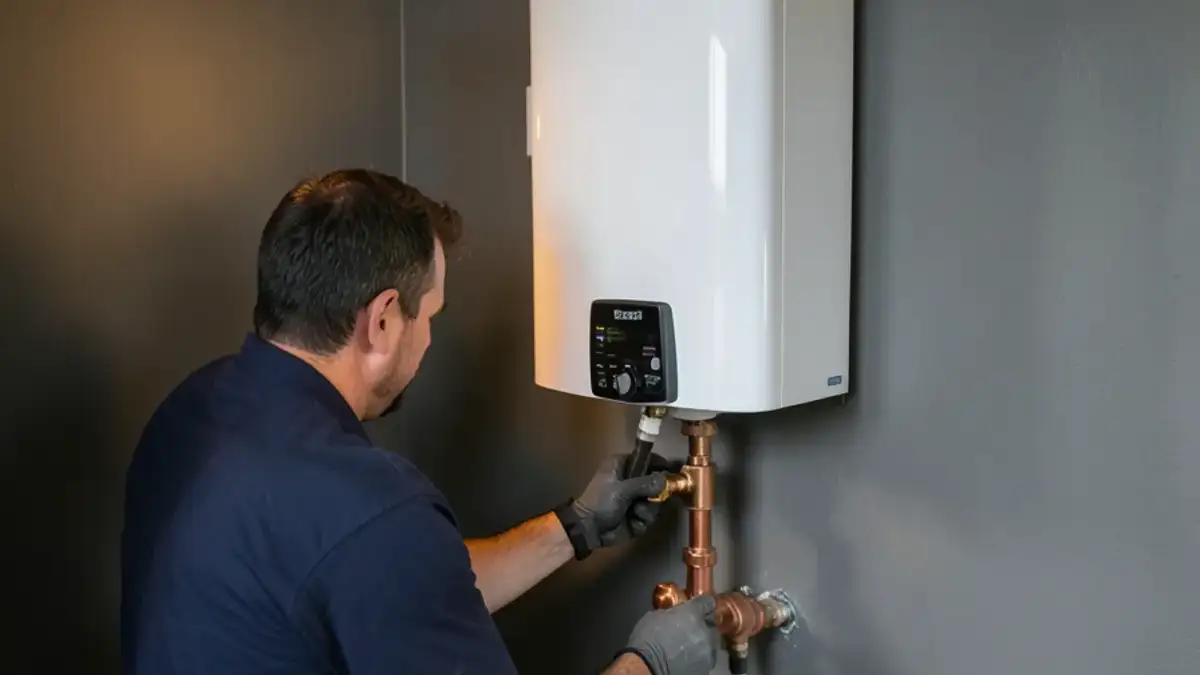
Tankless units are more sensitive because the passages are small. A Department of Energy Building America document notes that scaling of the low-mass heat exchanger is likely at higher temperature settings with high mineral content, and the coils should be flushed with a descaling solution per the owner's manual. Our comparison of tankless and tank water heaters weighs this against the savings.
How Do You Test Your Water Hardness?
Use the cheapest reliable source first, then confirm if the stakes are high.
- Public water: find the utility's latest annual water quality report. Hardness is usually listed there. Check the units, since some reports use grains per gallon and others use mg/L.
- Private well: use a certified lab, because a well can change with the season and the aquifer.
- Quick check: a home test strip gives a rough band, enough to tell moderate from very hard.
- Convert if needed: multiply grains per gallon by 17.1 to get mg/L.
Keep the result with your water heater paperwork. It helps size a softener, set a flush schedule and decide whether a tankless unit makes sense.
Should You Install a Water Softener?
Maybe, and the test decides. A softener swaps calcium for sodium or potassium, which stops new scale. It does not clear scale that is already in the pipes, and it needs salt refills. Wikipedia also notes softening is often unnecessary because most detergents counteract hardness, and where it is used it is often recommended mainly for water going to the hot water system.
Consider a softener when the test shows hard or very hard water and you see real symptoms: heater trouble, clogged fixtures, spotted dishes. If your results are moderate, a yearly tank flush and a vinegar soak for aerators may be enough. Our water softener installation page covers sizing and installation.
Penn State Extension calls water over 120 ppm hard but says whether to treat it is a personal choice. It also says bacteria or high iron has to be filtered out first, and that magnet, electronic and citric acid units have shown mixed results and are generally not recommended. For what a softener costs to run once it is in, read our post on what hard water costs in Central Illinois.
What You Can Clear Yourself
Fixture scale is a fair home job. Scale inside pipes is not.
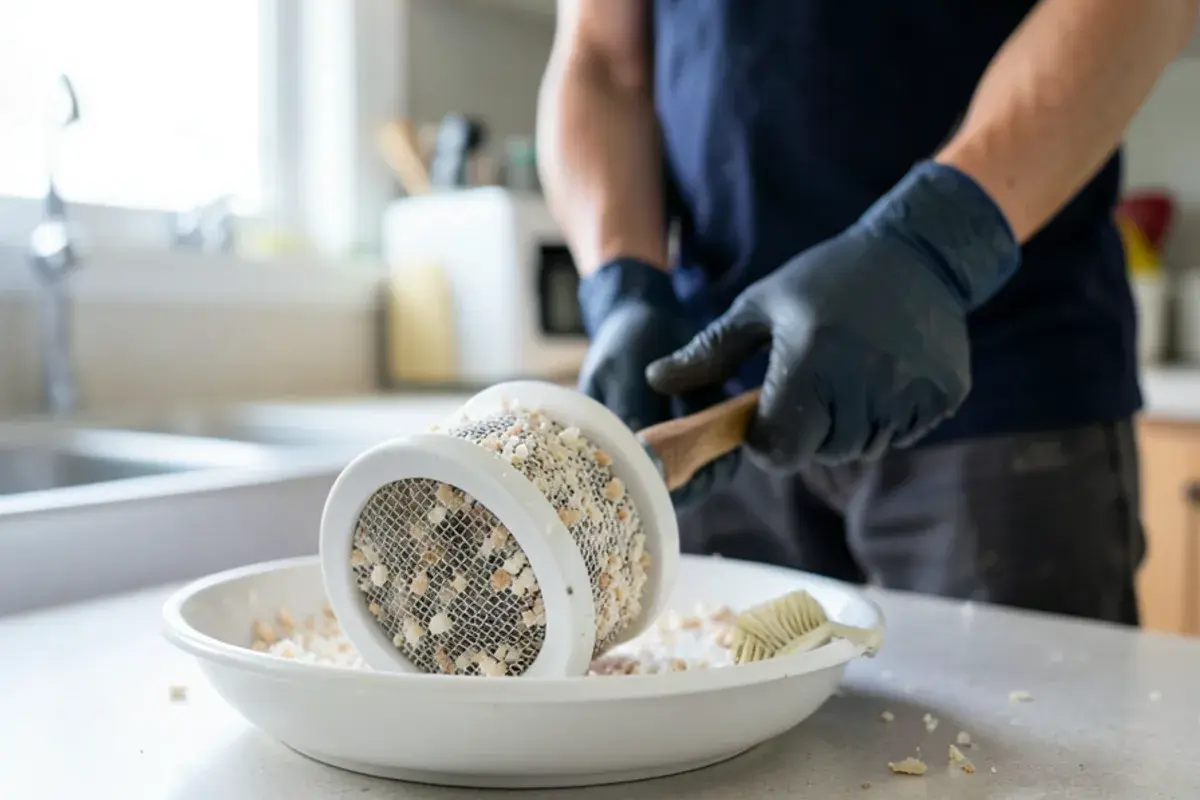
- Unscrew the aerator or showerhead, and protect the finish from the wrench with a cloth.
- Soak it in white vinegar for two to five hours, the range Hunker's guide gives.
- Scrub with a toothbrush and a chlorine-free scouring powder. Skip the baking soda, which only neutralizes the vinegar.
- Rinse it, refit it and run the water for a moment to clear loose flakes.
If flow is still weak, the trouble is farther back, in the valve or the pipe.
Can Hard Water Clog Drains Too?
It makes drains worse, though it is rarely the only cause. Hard water reacts with soap to leave a scum on tubs and drain walls, and hair binds into it. That is part of why a bathroom drain can clog repeatedly even with a hair catcher in place. Our post on why drains keep clogging covers the other causes and what to do about them.
What Do We Look For on Hard Water Calls?
We look at what the water has already done. On a heater call, that is the drain valve, the sediment that comes out and the condition of any exposed element. On a fixture call, we check the aerator and the cartridge. In older homes with galvanized supply pipe, scale adds to rust on rough walls, so pressure drops sooner. Older homes may still have galvanized lines, and Peoria Heights, with a median build year of 1957 (Census data), is a place we would check.
We give you the facts and a clear, upfront quote for whichever fix fits. Sometimes that is a new aerator, sometimes a flush, and sometimes a softener.
There is an honest limit to treatment. Softening stops new scale, but it does not bring back a tank that is already full of it or a galvanized pipe that has closed down. If your water heater repair quote is on a tank near the end of its life, spending on the tank first and softening later can be the wrong order. And if you are weighing tankless water heaters, the water test should come before the purchase.
Seeing Scale? Start With a Number
Find your hardness figure, then look at the heater and the aerators. If you have a reading and a symptom, call (209) 563-1400 and tell us both, along with the age of the water heater. We will say whether you need a part, a flush or treatment, and we would rather talk you out of equipment than sell you something the test does not support.
Sources
- City of St. Charles: Water Hardness (University of Illinois Extension chart)
- Wikipedia: Hard water
- Consortium for Advanced Residential Buildings (DOE Building America): Tankless Water Heaters
- Penn State Extension: Water Softening
- U.S. EPA WaterSense: Water Softeners, Technical Reference Manual fact sheet
- Hunker: How to Dissolve Lime Buildup With Vinegar and Soda

Written by the Professional Sewer & Drain Services team
A plumbing and sewer company based in Washington, IL. About us